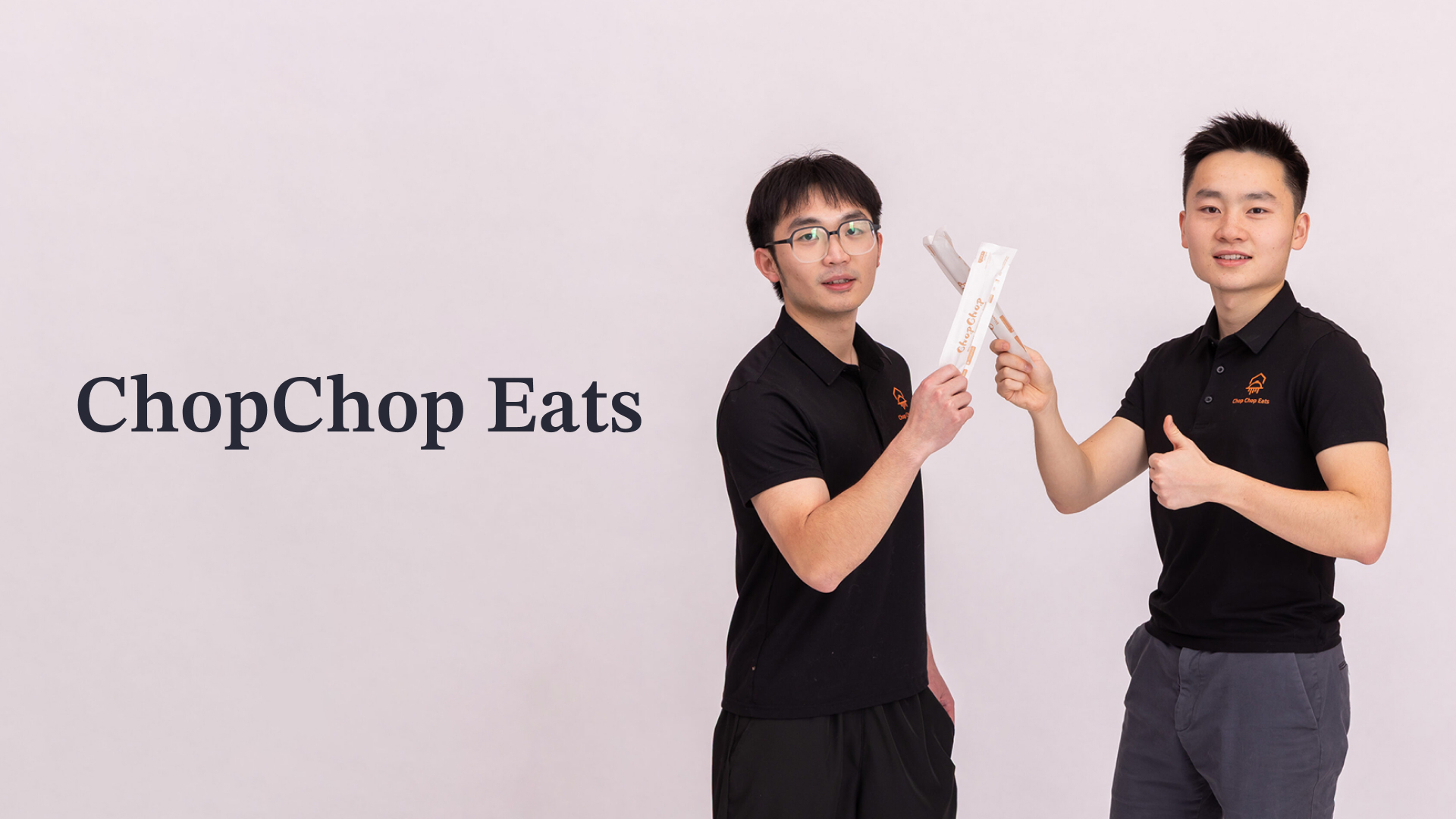
Team: Aaron Shen (Tandon ’24), Ice Yu
About the Venture: ChopChop Eats is a marketplace that enables home cooks to list homemade dishes and sell directly to nearby customers. The platform simplifies discovery, ordering, and fulfillment for locally prepared meals.
Tell us about ChopChop Eats and the problem it aims to solve.
ChopChop Eats is an online marketplace that lets skilled home cooks legally sell homemade meals, while giving customers access to healthy authentic homemade food that feels personal and cultural.
Many people want authentic healthy homemade food, but most of the food available today comes from restaurants or large delivery platforms. At the same time, millions of talented home cooks have no easy way to share their cooking or earn income from it. Opening a restaurant is expensive and complicated, and most delivery platforms only work with licensed restaurants.
We solve this by creating a platform designed specifically for home cooks. We help cooks go through food safety requirements, set up their menus, and reach local customers through our marketplace. Customers get access to fresh homemade meals, and cooks can turn their cooking skills into meaningful income.
How did the team come together?
I (Aaron Shen) met my co-founder (Ice Yu) while we were studying in an entrepreneurship program at Brown University. During the program, we worked on a class project exploring opportunities in the food and marketplace space.
As we researched the idea, we noticed a clear gap in the market. Many talented home cooks wanted to share their cooking and earn income, but the only realistic path was opening a restaurant, which is expensive and difficult. At the same time, many people were looking for authentic homemade meals that felt more personal than typical restaurant food.
After finishing the program at Brown, we continued working on the idea, spoke with cooks and customers, and eventually launched the first version of ChopChop Eats.
What sets ChopChop Eats apart?
Most food delivery platforms are built for restaurants, not individual cooks. ChopChop Eats is designed specifically for home cooks and the type of food they make.
Unlike large delivery apps that focus on speed and standardized menus, our platform focuses on authentic homemade meals. Each cook offers a limited menu based on what they actually cook well, and customers order directly from them. This creates a more personal food experience that restaurants often cannot provide.
Compared to other home-cook platforms, we focus on freshness and accessibility. Many platforms require meals to be pre-ordered days in advance. On ChopChop, customers can often order meals the same day and receive food that was just prepared.
Our goal is to make homemade food easy to access while giving talented cooks a practical way to earn income from their cooking.
What motivated you to apply to the Challenge?
I (Aaron Shen) first had the idea for ChopChop Eats when I was studying at NYU, so the NYU entrepreneurship community has always felt closely connected to this project. The Entrepreneurs Challenge felt like a natural opportunity to bring the venture back to that community and continue developing it.
What motivated us most is the chance to learn from experienced mentors and connect with other founders building early-stage startups. Building a marketplace comes with many challenges, and feedback from people who have built and scaled companies is extremely valuable.
Through the program, we hope to refine our business model, learn more about scaling the platform to new cities, and connect with investors, partners, and other entrepreneurs who can help us grow the platform further.
What has been the biggest turning point for you in your startup journey?
One of the biggest turning points for ChopChop Eats was when we launched our MVP and started seeing real people using the platform. Before that, the idea mostly came from conversations and assumptions about what people wanted. Once the platform went live, we were able to watch how customers actually ordered food and how cooks interacted with the system.
Within the first few months, we completed thousands of orders and onboarded dozens of home cooks. Seeing customers return and order again showed us that people truly value homemade food and the personal connection behind it.
That early traction changed how we approached the business. Instead of just validating an idea, we shifted our focus toward improving the product, supporting our cooks, and figuring out how to scale the marketplace to more communities.
What have been the biggest challenges you’ve faced so far?
One of the biggest challenges has been building trust on both sides of the marketplace. For home cooks, many people were unsure if they were legally allowed to sell homemade food or whether customers would actually buy it. For customers, ordering from individual cooks instead of restaurants was also something new.
We addressed this by focusing on safety, transparency, and quality from the beginning. We verify cooks, require food safety certifications when needed, and review menus before they go live. We also started small in local communities so we could closely monitor orders and gather feedback from customers.
As more customers tried the food and shared their experiences, trust started to grow naturally. That early community support helped us build momentum and continue expanding the platform.
What are some recent milestones?
One recent milestone for ChopChop Eats has been launching our marketplace and reaching early traction with both customers and home cooks. Since launching our MVP, ChopChop Eats has served more than 1,000 customers, completed over 2,000 orders, and onboarded 45 active cooks on the platform.
Another important milestone has been building strong interest from cooks who want to join the platform. So far, more than 500 cooks across different states have applied to sell on ChopChop Eats, which shows strong demand from people who want to share their cooking and earn income.
Reaching these milestones has been both exciting and challenging. Because ChopChop Eats is a two-sided marketplace, we need to grow both cooks and customers at the same time. This has required constant outreach, testing, and learning from our users as we continue improving the platform.
What advice would you give to aspiring entrepreneurs, especially those just starting out?
One piece of advice is to start talking to real users as early as possible. It is easy to spend a lot of time building an idea without knowing whether people actually want it. Early conversations with potential customers can quickly reveal what works and what needs to change.
Finally, persistence matters a lot. Building a startup involves many challenges and uncertainty. Progress often comes from continuously learning, adapting, and improving the idea step by step rather than expecting everything to work perfectly from the start.