Team: Jordan Sotudeh (CAS ‘12), Julian Jazayeri, Alvan Mbongo, Elena Empino
About the Venture: Venaera builds modular heat pump systems designed for rapid installation, easier servicing, and improved efficiency through embedded data collection. The product uses sensors and machine learning to detect issues early and reduce operating costs and emissions.
By Jordan Sotudeh, Founder of Venaera
Nobody tells you this when you start a company: the loneliness is one of the hardest parts.
You have an idea that consumes you. You see a problem others overlook, a gap in the market that feels obvious once you notice it. You’re energized, maybe a little terrified, and almost certainly (at some point) completely alone in a room wondering if any of it makes sense. That was me, early in building Venaera.
What changed everything wasn’t a single breakthrough moment or a perfectly timed fundraise. It was finding the right people — advisors, peers, and organizations who didn’t just cheer me on, but pushed me harder, challenged my assumptions, and showed up when it mattered.
Here’s what I wish I’d known from the start.
One of the most valuable things I’ve done as a founder was go on a podcast long before I thought Venaera was ready for that kind of exposure. We didn’t have a polished story. I was still figuring things out. A part of me said: wait until you have more to show.
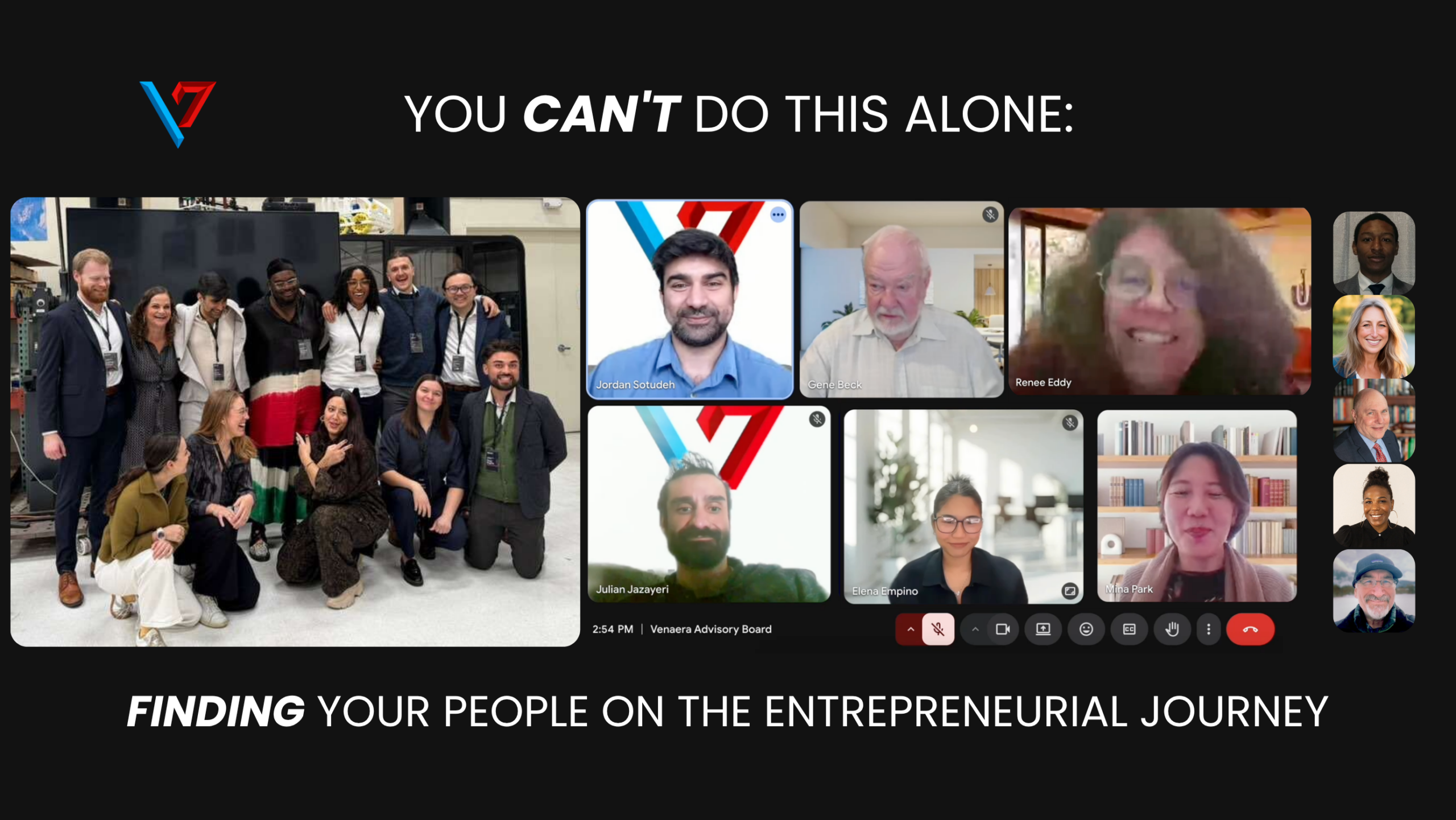
I did it anyway — and it changed the trajectory of our advisory board.
The episode of David Carr’s Steward Your Business led to introductions I never would have engineered on my own. Those introductions cascaded through networks I didn’t even know existed, and eventually brought a C-suite executive from a prime player in our field onto our advisory board. That single relationship has been invaluable — the kind of strategic insight and credibility that would have taken years to access otherwise, if ever.
The lesson isn’t “do podcasts.” The lesson is that visibility creates surface area for luck. Every conference talk, every panel, every article, every conversation you have in public is a potential connection point you can’t predict in advance. You don’t need to be perfect. You need to be present.
The best advisory relationships I’ve found share three traits: the person has been in the weeds themselves, they’re willing to say “that’s wrong” to your face, and they’re genuinely invested in your specific problem or in you — not just the space in general. And often, those people find you when you show up consistently and openly. Structure matters once you find them: set clear expectations, a cadence, a defined domain, and a small equity stake that gives them real skin in the game. But first, you have to be findable.
No one understands the day-to-day of building a startup like another founder who is in it with you, right now. Not a mentor who did it fifteen years ago, not a professor who studied it, not a well-meaning friend or family member. Another founder who is losing sleep over the same things you are.
Every accelerator and grant program I’ve been part of has delivered this in its own way. Los Angeles Cleantech Incubator and Walking Softer introduced me to mission-driven founders I still call when I’m thinking through a hard decision. FoundersBoost and PeachScore brought together cohorts that were ruthlessly honest with each other in a way that formal mentorship rarely is. The NYU Entrepreneurs Challenge has done the same — being surrounded by people wrestling with real problems in real time, co-founders navigating equity conversations, early-stage teams figuring out their first hire, solo founders deciding whether to pivot. These conversations, informal and unscripted, taught me more than almost any formal resource.
Seek out founder communities wherever you can find them. Be generous with what you know, and people will be generous back. Your peer network is a long-term asset that compounds over time.
When I was just starting out, I had no idea what I was doing or where to begin. I didn’t have a network in cleantech. I didn’t know the landscape of investors, accelerators, or organizations in the space. So I did what anyone does when they’re lost: I Googled it.
I searched “cleantech accelerator [my city]” and found my first program. It sounds almost embarrassingly simple, but that search changed everything. That program taught me the fundamentals: how to think about the market, how to talk about the technology, how to build a business around a hard problem. It introduced me to the cleantech ecosystem from the ground up and gave me a network in a space I was completely new to. The relationships I built there are ones I still value deeply, both professionally and personally.
I tell this story because I think founders — especially first-time founders — often assume the path into a new industry requires a warm introduction or a lucky break. Sometimes it’s just knowing what to search for. The programs exist. The communities exist. They’re often waiting for exactly the kind of person who is hungry enough to go looking.
When evaluating programs, I look for three things: access to real operators, a strong alumni network that actually stays engaged, and programming that meets you where you are; whether that’s idea stage, MVP, or early traction. The ones worth your time will feel uncomfortable in a productive way.
Building Venaera has taught me that entrepreneurship is a team sport, even when you feel like you’re playing it alone. The quality of your support network — your advisors, your peer founders, the organizations that invest in your growth — will shape your company as much as any product decision you make.
If you’re just starting out, my single biggest piece of advice is this: don’t wait until you need help to build those relationships. Start now. Go to the events. Apply for the programs. Ask for the coffee meeting. Do the podcast before you feel ready. Be honest about where you’re struggling.
The right people are out there. But you have to show up to find them.