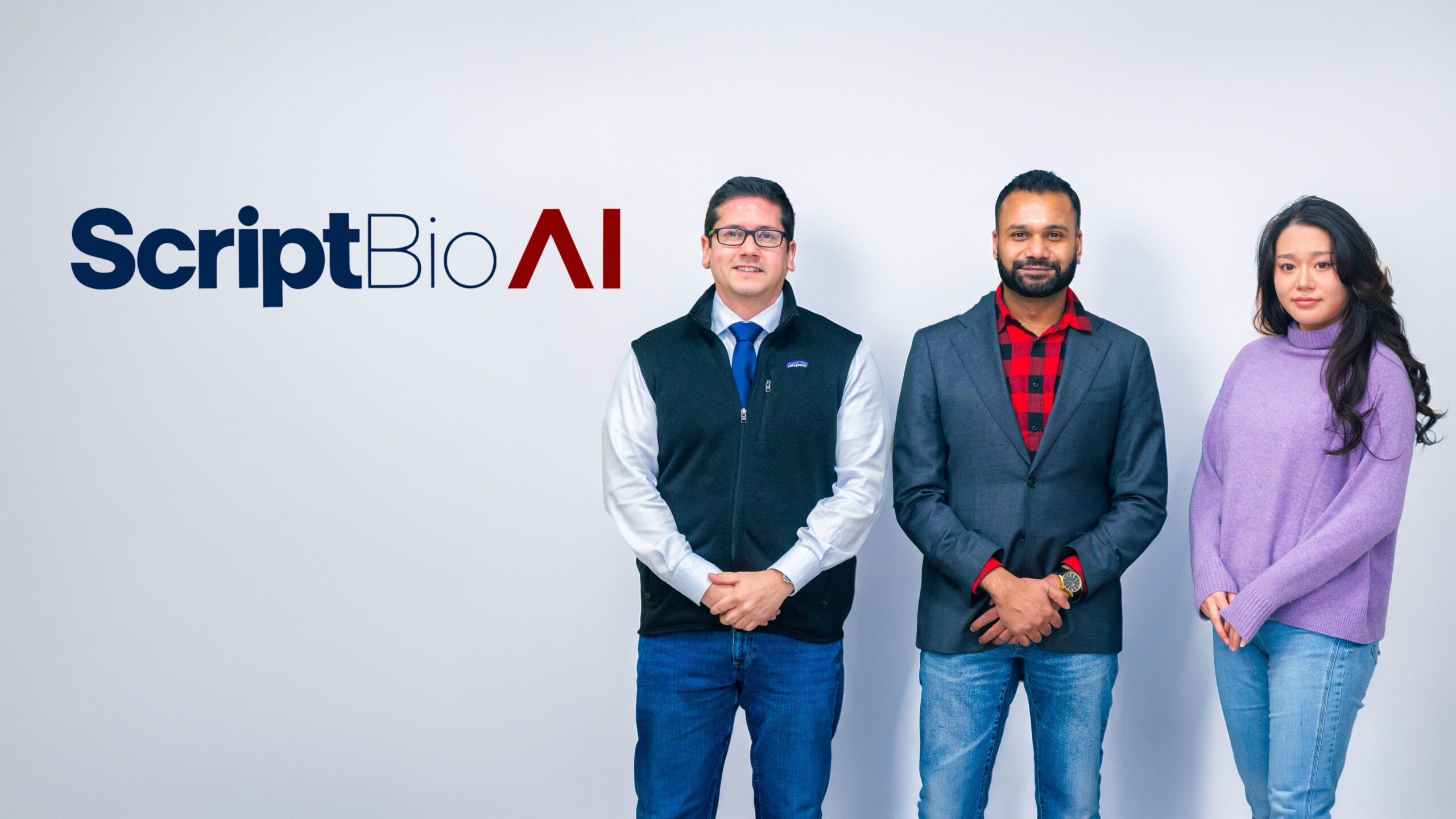
Team: Patrick (Pat) Ovando Roche, PhD, Azzam Naeem (Stern), Magnolia Cheng
About the Venture: ScriptBio AI develops therapeutics that target biological hallmarks of aging, such as chronic inflammation, to help prevent age-related disease. The company is starting with knee osteoarthritis as an initial indication due to its localized biology and clear clinical measures.
Tell us about ScriptBio AI and the problem it aims to solve.
Today’s drugs for diseases like Alzheimer’s, Parkinson’s, and osteoarthritis don’t address root causes, they manage symptoms after the damage is already done and irreversible. We’re treating these diseases too late, and there’s no going back once the biology has broken down.
ScriptBio AI is building preventive medicine for age-related disease. Because intervening late doesn’t work, we need to start earlier, finding which genes drive disease before onset, so we can deliver restorative factors before the damage becomes irreversible. We use AI to identify those causal drivers from patient data, then engineer stem cells to deliver the therapeutic fix.
The scale of this problem is massive. By 2050, 2.1 billion people will be over 60, and the majority will develop multiple chronic conditions, costing the U.S. alone over $4.5 trillion annually. We’re starting with knee osteoarthritis, a rapidly growing market with no disease-modifying treatment available.
But the problem isn’t only biological. Drug development has a 90% failure rate, driven by selecting the wrong targets, slow decision-making, and enrolling the wrong patients. ScriptBio AI addresses all three, using our causal AI engine for drug discovery, our AI agentic hive for operations, and our digital twin for patient selection.
What inspired you to take this step into entrepreneurship?
I’ve always been drawn to frontier biology. Over the last 16 years, I’ve built the scientific, engineering, and manufacturing mindset across academia, biotech, and large pharma, working in stem cell biology, gene editing, and translational development at Imperial College, Harvard Medical School, CRISPR Therapeutics, Sana Biotechnology, and Astellas Pharma.
During my time in biotech, I was asked to bring a new indication into my company’s pipeline. I worked on business development, hiring key opinion leaders for consulting, running due diligence, and competitive landscape analysis. I loved the strategy side of it, but I noticed that several deals fell through even when the science made complete sense. I realized I had a business mindset gap, and it got me interested in entrepreneurship.
A few years later, my parents got sick. My father developed Parkinson’s, my mother Alzheimer’s. Seeing up close how devastating these diseases are and how little current treatments do, I knew I wanted to do something about it.
To bridge that gap, I applied to MIT Sloan, where I’ve been focused on entrepreneurship and AI. That combination, deep biology, a personal mission, and the AI revolution, made this the right moment to build ScriptBio AI.
What sets ScriptBio AI apart?
Most companies in osteoarthritis do one of two things: they either use AI to look for drug targets, or they use stem cell therapy without knowing which biological drivers they’re trying to address. We integrate both.
Mesoblast ran clinical trials with unmodified mesenchymal stem cells and failed to meet key endpoints, the cells weren’t potent enough. Cynata Therapeutics uses iPSC-derived MSCs with better manufacturing, but still injects cells with no specific gene targets. They’re hoping the cells do the right thing on their own.
ScriptBio AI takes a fundamentally different approach. Our AI identifies causal disease drivers, not just correlations, from over half a million single-cell transcriptomes across dozens of patients. We then engineer iPSC-derived MSCs to deliver the specific therapeutic factors designed to counter the dysregulation our model identifies.
Our engineered cells are designed to provide sustained therapeutic benefit from a single injection, reducing inflammation, pain, and slowing cartilage breakdown, with the ultimate goal of preventing or delaying knee replacement. Unlike repeated cortisone shots that wear off in weeks, an engineered living cell continues working inside the joint.
What motivated you to apply to the Challenge?
The NYU Entrepreneurs Challenge came at exactly the right moment for us. The bootcamps sharpened how we pitch and how we think about company building, and the mentor network has been genuinely valuable, especially connections beyond the biotech world we wouldn’t have accessed otherwise.
The mentorship has already been valuable, but the $75,000 prize could be catalytic for us. We have lab space secured at LabCentral’s AI BioHub in Cambridge, and we’ve been accepted to the C10 Labs AI Nexus in New York City. We have 15 AI-identified gene targets ready to test. What we need is funding for the consumables and reagents to run the first wet-lab validation of our targets.
That data is the single most important thing standing between us and our $5M seed round. The NYU prize would let us generate it this summer, turning ScriptBio AI from a computational platform into a company with biological proof.
What has been the biggest turning point for you in your startup journey?
The moment our AI model recovered known osteoarthritis genes, targets that took the field years to identify, and then surfaced novel ones not in any existing database.
We had spent months building the pipeline: curating several datasets, engineering a cell classification system, fine-tuning a foundation model. For a long time, it was pure infrastructure with no way to know if the outputs would be biologically meaningful.
When the results came back, cross-validated against genetic studies, proteomics, and methylation data, the known biology was there. But it was the novel findings, 15 potential disease drivers validated across three independent data modalities, that changed everything.
That was the first moment I felt we had something real, not just an interesting idea, but the foundation of a company. It gave us the confidence to start the provisional patent application process and commit fully to turning these computational predictions into something that could help patients.
What have been the biggest challenges you’ve faced so far?
The biggest challenge has been doing everything at once. Participating in accelerators, applying to pitch competitions, seeking non-dilutive funding, building the AI pipeline, writing weekly mentor reports, meeting with IP lawyers, managing the team, all while finishing my MBA, which wraps up in six weeks.
There were stretches where I was in class during the day and spent the entire night building the AI engine. You have to wear every hat, then learn when to delegate. Having Azzam’s AI expertise and Magnolia’s computational biology skills has been critical for pressure-testing our technical decisions.
I’ve dealt with it by getting ruthless about prioritization and learning when to delegate instead of trying to do everything myself. The hardest part isn’t any single task, it’s context-switching. One hour you’re debugging a machine learning pipeline, the next you’re refining a pitch, the next you’re reviewing a patent filing.
But I wouldn’t change anything. The fact that I’m willing to virtually not sleep while working on this is how I know this is what I’m meant to be doing.
What are some recent milestones?
In the last several months, we’ve made progress across technology, partnerships, and external validation.
On the technology side, we validated our AI prototype: a fine-tuned foundation model trained on over 541,000 single cells that identifies causal disease-driving genes. We reached MVP stage and are now advancing our next-generation model on dedicated high-performance hardware.
On the partnership side, we were accepted into LabCentral’s AI BioHub in Cambridge, one of the most competitive biotech incubator spaces in the country, alongside the C10 Labs accelerator. We were selected for the C10 Labs NYC AI Nexus, became an NVIDIA Inception program partner, and were invited to the Imagination in Action AI Summit at MIT. We’ve begun early investor conversations, which has been encouraging. And advancing to the NYU Stern Entrepreneurship Challenge semifinals has been an important validation.
What we’re working toward now is the bridge from computation to biology. With our LabCentral lab space secured, we’ll begin the first wet-lab experiments to validate our AI-identified gene targets. That data unlocks our seed round, our NIH grant applications, and ultimately the path toward a therapy that could help patients.
What advice would you give to aspiring entrepreneurs, especially those just starting out?
Build substance first. Put your head down and build something that actually works.
Especially if you’re in an accelerator or doing an MBA while building your company, there will be a lot of noise around you. People talking about ideas, launching websites, posting on LinkedIn about what they’re going to do. Ideas are cheap. A lot of people start with the front end, I’d suggest the opposite. Build your product, show that it works, then go out and start networking. And when you do, make sure everything is tight, because your credibility is at stake.
There’s never a perfect moment to start. But you’ll feel when the time is right. And when it comes, make sure it’s something you’re genuinely passionate about. I’d personally stay away from starting a venture just to make money. Go after something big, something that could change things, something that could help people, something inspiring. I can’t think of a better use of time.
We’re living in a moment where the technology available lets you move incredibly fast if you have the motivation and are willing to do the hard work. So find a big problem that drives you, and tackle it full on.